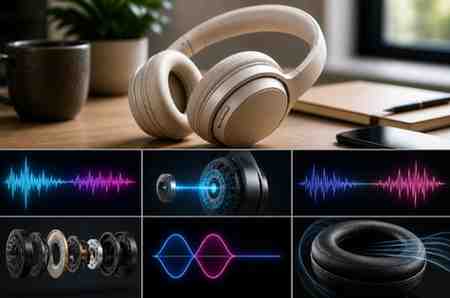
It is fascinating how something that tiny can turn a loud environment quiet. One minute, you are immersed in chatter or traffic and the next moment it’s peaceful. It is as if someone just hit mute on everyone outside.
This is actually why I wanted to shed some light on how do noise cancelling headphones work, in a way that makes sense. No heavy science. No confusing terms. Just the simple explanation that you could follow on ☝🏼
The simple science behind it (and not making your head spin)
Active noise control versus passive noise control
Noise Cancellation available today
Where these headphones work best
Where they don’t work as well
What are they and why they use it in their daily life
Common myths people believe
Safety and practical concerns
What Is Noise Cancellation?
For example, I like to think of noise cancellation as sound control rather than sound removal.
It doesn’t erase sound completely. Rather, it diminishes or silences selected noises so they are less palpable.
This can happen in two, and only two ways:
Blocking sound physically
Cancelling sound using technology
Both approaches seek to quiet your surroundings. Just in different ways.
Working Principle of Noise Cancelling Headphone (Simple Explanation)
Now allow me to keep this as simple as possible.
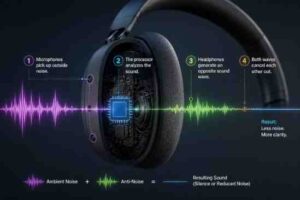
I generally describe how do noise cancelling headphones work in four steps.
Now this is how it works:
Step 1: The microphones will hear the noise that is outside
It has tiny microphones embedded inside these headphones. They hear the noise in your surroundings:
Engine noise
Air conditioning
Background hum
Imagine as if your headphones are paying attention to the environment,
Step 2: SOUND ANALYSIS (PROCESSOR)
Hidden in the headphones, there is a little chip.
It analyzes the incoming sound wave and identifies the pattern.
This happens instantly. No delay you can notice.
Step 3: Sound waves that are the opposite of each other get generated by the headphones
This is the interesting part. Then, the headphones create an exact anti-sound sound wave of the incoming noise.
This one goes down if the outside sound is raised.
Phase Cancellation Overlap
Step 4: The two Sounds Cancel each other
They cancel each other out when these two waves collide.
This is called destructive interference.
I love to describe it this way:
+1 and -1 = 0
So consider that they are in essence doing this all with sound within your headphones.
Why It Works Well, Without Getting Too Scientific
I am not going to make this a physics class. But a little understanding helps.
Sound travels in waves.
These waves have:
Peaks
Troughs
If two waves are perfect opposites, they cancel.
So that is how do noise cancellation headphones work in technical terminology.
The key is timing. Your headphones have to produce that inverted wave, and almost immediately. They must be slow enough and if they are too slow, the effect does not get through.
Active vs Passive Noise Cancellation
THAT IS where a lot of people get mixed up.
Let me simplify it.
Passive Noise Cancellation
This is just physical blocking.
Examples:
Thick ear padding
Over-ear design
It is like putting your hands over the ears. Simple and effective.
Active Noise Cancellation (ANC)
This is the technology-based method.
It uses:
Microphones
Processors
Opposite sound waves
It is this method that most people are referring to when searching to explain how noise-cancelling headphones actually work.
Types of Noise Cancellation
Most of the people I have noticed, are not even aware that there are different types on How Do Noise Cancelling Headphones Work. But understanding is helpful.
Feedforward ANC
Microphones are placed outside
Know in advance before this noise reaches your ears
Works well in controlled environments.
Feedback ANC
Microphones inside the ear cups
Tweak based on what you actually hear
More accurate but slightly complex.
Hybrid ANC
This combines both methods.
It is what you are getting in high-end models like
Sony wireless noise cancelling headphones or something of that magnitude
Where Noise Cancelling Works Best
I ran this on different setups and the results were always the same.
Works Best For:
Airplane engine noise
Office background hum
Fan or AC noise
Long, steady sounds
These are predictable sounds. Easier to cancel.
Real-Life Example
Imagine sitting on a plane.
Without headphones: You hear the continuous engine noise.
With ANC: That sound fades to the back.
It never really fully goes away but it fades significantly into the background.
Where It Doesn’t Work As Well
This part is important.
Noise cancelling is not magic.
Less Effective For:
Human conversations
Sudden loud noises
Irregular sounds
Why?
Because these sounds change quickly. The system is simply not capable of reacting quickly enough.
Why People Use Noise Cancelling Headphones
I see three main reasons.
1. Focus
A lot of professionals use them to help them focus.
I even learned some useful productivity tiphs from a page Ecteclusplus dedicated to.
that correspond really well to this concept of controlling the environment.
2. Travel Comfort
Planes, trains, buses they’re noisy.
These headphones reduce that stress.
3. Sensory Support
Others wear them to be more comfortable in loud locations.
This is the reason, therefore, searches like best noise cancelling headphones for autism are on the rise.
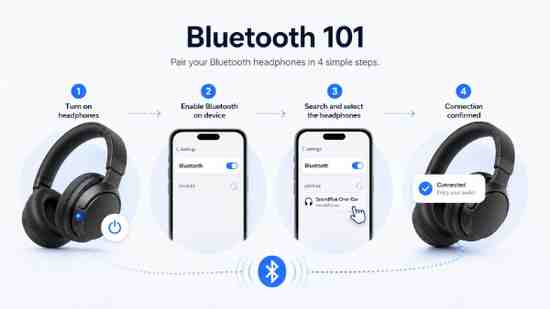
Bluetooth and Wireless Convenience
Now, in today’s world it is normal for headphones with active noise cancelling to also be wireless enabled.
So you’ll see terms like:
Bluetooth and how do noise canceling headphones work for it
This simply means:
Wireless connection
Built-in noise cancellation
Convenience meets functionality.
Are Noise Cancelling Headphones Safe?
Short answer: yes.
Well however, I keep it real.
What I Keep in Mind
Don’t use extremely high volume
Take breaks
Stay aware in public spaces
That’s it.
Used properly, they’re completely safe.
Common Myths I Often Hear on How Do Noise Cancelling Headphones Work
Let’s clear a few things up.
Myth 1: They Block All Sound
Not true.
They reduce noise. They don’t eliminate it completely.
Myth 2: They Damage Hearing
This is only if used at very high volume.
Myth 3: They Work the Same Everywhere
No.
They respond better to repetitive sounds as opposed to erratic ones.
Real-World Use Cases
I HAVE PERSONALLY SEEN people do these practically.
At Work
Blocking office noise
Improving focus
During Travel
Reducing engine noise
Making long trips less tiring
At Home
Creating a calm environment
Reducing distractions
For a slightly more technical description of how sound waves cancel one another, Sono’s this source helped me out.
It breaks the concept in an intelligible and organized way.
Resources For Internal Use That Might Help
If you would also like to increase some focus and productivity and basic thing like how to use a headphone, not only how do noise cancelling headphones work then I recommend seeing eclectusplus guide like this.
The practical are aligned closely with controlling your environment.
Utilizing on How do Noise Cancelling Headphones Work in your Daily Life
These headphones tend to be useful in a more habitual sense. For instance, I use them while working in focused sessions or when travelling. Eventually, my brain begins to link donning them with less noise and a quieter, more controlled environment. It may be a tiny habit, but it helps me get into the mode of concentration all that bit quicker. I do not require the full spectrum of noise to be quiet, just more silence in it.
How to Choose Type for Your Purposes
Not every pair behaves the same way in each and every situation is something I always keep in mind. While some are best for travel, others seem more suited to home or office. For those times when I am up and about, I want something lightweight and wireless. It does allow for longer hours in the chair and comfort simply is more important than anything else. The aim is really simple: choose something that will seamlessly slip into your day, so that you use it rather than leave it on your desk.
Frequently Asked Questions
How do noise cancelling headphones work in simple terms?
How do noise cancelling headphones work Basically is, this noise cancelling headphones type will take the form of a noise-cancelling signal. They pick up noise from the outside and create an equivalent sound wave to negate it.
Do they remove all noise?
No. Click, offer away fantastic at reducing constant backdrop noises instead of unexpected kinds.
Are they good for work?
Yes. People use them as they are good to focus the mind.
Can kids use them?
Yes, especially in controlled environments. Just monitor usage and volume.
Do expensive headphones work better?
Usually, yes. Better technology is used in higher-end models, for example providing a more powerful sound cancelling.
Final Thoughts
Anyways, I think of these as sound managers, not sound eliminators. After learning how do noise cancelling headphones work, it was easier to pick the right type and use them properly.
They should not have to be anything complicated
They just need to:
Respond quickly
Fit comfortably
Cut the right noise
With those things established, the difference is palpable.
And frankly, with all the noise nowadays in the world, quiet really helps a lot.