Samsung vs Apple
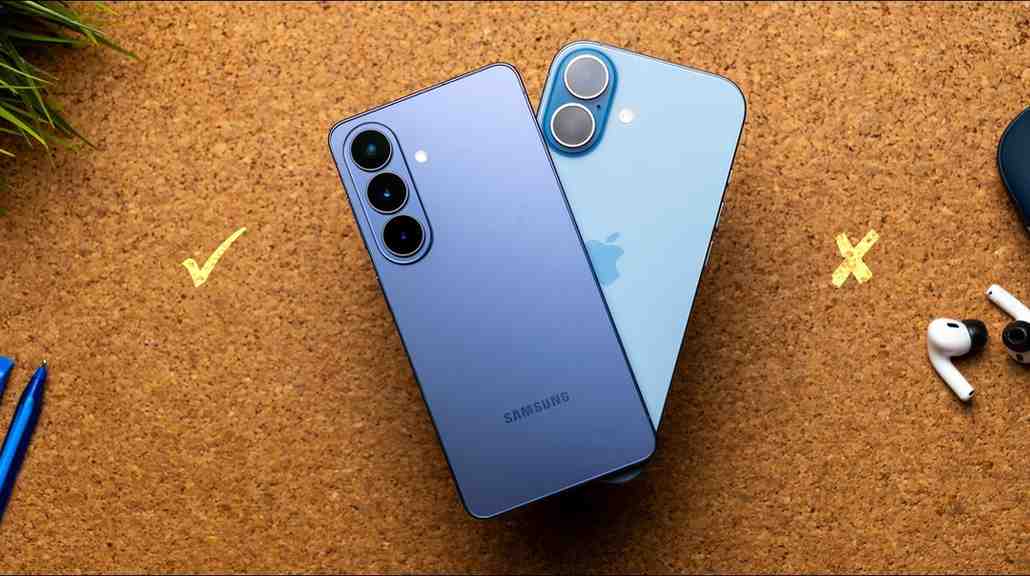
Samsung charged $100 more than Apple for the base flagship this year, and they’ve had to increase production by 500,000 units just to keep up with the demand. So, what exactly is the Galaxy S26 doing that makes people pay more than the iPhone 17? And look, I usually give the win to the Galaxy when I compare base models, but this time it’s different. And the iPhone 17 was already Apple’s biggest upgrade to the base iPhone in years. Promotion, dual 48 megapixel cameras, faster charging. Now, from a design standpoint, the Samsung looks like a Samsung. Squared off edges, flat sides, matches the rest of the S26 lineup.
The Design Surprised Me
It’s lighter and thinner, 167 g and 7.2 mm compared to the iPhone 17 at 177 g and 8 mm thick. The iPhone is a tiny bit heavier, but honestly, it feels more comfortable to hold. The edges are softer, more contoured. Both phones are aluminum this year, which is worth calling out. Samsung moved away from titanium on the Ultra. Apple moved away from titanium on the Pro. The entire industry collectively decided titanium wasn’t worth the extra cost. The iPhone does give you two extra buttons. You have the action button on the left, which you can map to any shortcut, and the camera control on the bottom right, which launches your camera instantly. Now, I personally don’t use camera control much, but some people absolutely love it. The bigger difference is how you unlock these phones. Face ID on the iPhone is more accurate and more secure. There’s an infrared sensor, so it works perfectly in the dark. The Galaxy S26 has facial recognition, but it struggles a bit in low light. You do get that ultrasonic fingerprint scanner on the Samsung, which some people prefer. And look, living in a colder climate, I always lean towards face unlock, especially when you have gloves on. And yes, you can buy gloves that allow you to touch the screen. Now, one thing you’ll notice right away, one has a dynamic island and the other has a hole punch. And the front cameras are quite different.
The Selfie Camera Trick Most Phones Can’t Do
The iPhone 17 is using an 18 megapixel center stage sensor. And this is one of the best selfie cameras on any phone right now. The big feature is that it uses the entire sensor for both vertical and horizontal video. So, you can hold the phone upright and still get 16×9 framing. This just looks way more natural when you’re walking and talking. On the Galaxy, you have to hold it sideways for widescreen, which shifts you off center. Now, dynamic island lets you interact with live activities. Tap to jump back into music. Timers, navigation. Samsung has their own version of this in the corner. I actually like some of Samsung’s animations better, like the fold car popup looks nicer, but functionally neither is dramatically better than the other.
One Display Does Something Better Outdoors
Both phones have a 6.3 in display with 120 Hz adaptive refresh rate. And look, the fact that the base iPhone finally has prootion is a huge deal. This is the first time a nonpro iPhone has ever gotten adaptive 120 Hz and always on display. That gap existed for years and Apple has finally closed it. Now look, both displays are gorgeous. Samsung tends to push colors a bit more saturated, which makes videos look more pleasing to some people. The iPhone goes for more accurate color reproduction. Where the iPhone actually pulls ahead, though, is brightness. 3,000 nits of peak brightness versus 2600 on the Galaxy. That’s a 400 nit gap. Not dramatic indoors, but outdoors in direct sunlight, especially watching HDR content, you’re going to notice it. Now, on the S26 Ultra, the bigger, more expensive one, you get that anti-reflective coating, which I personally love, and I wish every phone had it. But neither the base S26 nor the iPhone 17 have that full anti-reflective coating. The iPhone does reduce reflections by about 33% compared to the previous generation. So, you will get slightly less glare on the iPhone compared to the S26. All right, these are the front-facing cameras on the iPhone 17 and the Samsung Galaxy S26.
Front Camera Test Footage
Uh, looks like Samsung’s cropped in a little bit more than the iPhones. I wish it was a sunnier day today cuz right now the clouds are nice and gray, so everything is going to look good. So, I guess it’s really going to come down to what you guys think of their color choices, right? Do you like Samsung’s better or do you like the iPhones? Either way, let me know how it looks and uh most importantly, which one has the better microphone. But here’s the thing, and this was my biggest complaint about previous base galaxies. They always had smaller batteries and battery life absolutely suffered.
The Battery Problem Nobody Talks About
And this year, it’s completely different because Samsung bumped the S26 up to 4,300 milliamp. And it makes a real difference, especially when you combine it with a more efficient processor. In day-to-day use, the screen on time is remarkably similar between both phones. I’m getting around 7 to 8 hours depending on what I’m doing. But here’s what nobody’s talking about. Like, if you live in India, Europe, or pretty much most of the world outside of North America, your Galaxy S26 doesn’t come with the Snapdragon 8 Elite Gen 5, it comes with Samsung’s Exynos 2600. And look, the battery difference is significant. Testing shows the Exynos version can drain up to 28% faster than the Snapdragon version running the same tasks. Like if you’re in Exynos region, the iPhone 17 generally gives you better battery life. That’s a real consideration for a massive portion of Samsung’s audience. But charging speed, and this one is absolutely clear, the iPhone charges nearly twice as fast. 40 watts versus 25. you get to 50% in about 20 minutes on the iPhone versus 40 to 50 minutes on the Galaxy. If you want faster wire charging on a Samsung, you have to buy the Ultra. And like that’s crazy to me. Samsung should have faster charging on the base model by now. Both of these phones are rocking very powerful chips.
Why Your S26 Might Be a Different Phone
The A19 in the iPhone and the Snapdragon 8 Elite Gen 5 in my Galaxy S26. Though again, most of the world gets Exonos 2600 instead. And look, this is where it gets crazy to me because single core performance, the iPhone still wins. The A19 has some of the fastest single core speeds on any phone, period. That translates to snappier app launches, faster website loads, things you actually feel in daily use. Multi-core is where the Snapdragon S26 pulls ahead, and it’s competitive and ray tracing and GPU benchmarks, too. Like if you’re someone who’s editing video on your phone or doing heavy multi-threaded work, the Snapdragon version will feel faster in those sustained tasks. Now, during my stress test, the Galaxy actually had better stability, but the iPhone under extreme demand had faster speeds and faster loops overall. Battery drain was interesting, too. The iPhone drained 15% during the test compared to only 12% on the Galaxy S26. But here’s the honest truth about day-to-day use. These processors are so far ahead and now that it’s hard to buy a slow phone, like checking emails, scrolling, gaming, like they’re both going to feel ridiculously fast, especially because they both have 120 Hz displays. Like, if gaming is your top priority, the iPhone gives you better frame rate consistency.
MagSafe, Charging & Connectivity
The Galaxy is more than capable, but Apple still edges out in gaming optimization. I should also mention that if you want a full-fledged desktop experience in a pinch, you can load up decks on your Galaxy S26. This will give you proper windows to work in and more screen real estate to use. This could be the difference for some people of only having to carry one device instead of two or even just having to save a lot more money.
Camera Test: One Phone Falls Apart at Zoom
But let’s talk about what’s most important to a lot of people, the cameras. And the Galaxy S26 has three cameras, 50 megapixel wide, 12 megapixel ultra wide, and a 10 megapixel three times telephoto. The iPhone 17 has two 48 megapixel cameras, a wide and an ultra wide. During the day, they process images differently. The Galaxy tends to introduce a bit more magenta, is more aggressive with sharpening, and likes to brighten up images. The iPhone is warmer, more contrasty, just a different style. There’s no wrong answer here. Honestly, it really comes down to what you personally prefer. Where the Galaxy does win, though, is obviously zoom. As soon as you pass two times, the iPhone has to crop in. But the Galaxy at three times is using a real telephoto lens. You just get cleaner shots. At 10 times, the Galaxy is still producing usable images while the iPhone falls apart. Digital zoom goes up to 30 times on the Galaxy versus 10 times on the iPhone. Though, honestly, 30 times is very pixelated. It’s useful for reading a sign in the distance, but I wouldn’t use it for actual photos. Selfies, both are good. Again, the Galaxy sharpens a bit more aggressively. Colors are close. Video is where the iPhone consistently wins. It’s warmer, more contrasty, and the stabilization and color consistency are still bestin-class. The one thing that Galaxy does really well is give you pro options on the base model. You want log recording, you get it on the S26. On the iPhone, you need to buy the Pro to get that. For some creators, that actually might matter.
Night Photography — Which Keeps the Mood?
Nighttime photography is interesting. The Galaxy’s telephoto obviously gives it better night zoom shots. If you’re shooting at three times or 10 times in the dark, Galaxy wins. But the main camera at night, I find the Galaxy tends to oversharpen things again, and you notice it more in low light. Samsung also tries to make night shots look brighter, almost like daytime, whereas the iPhone preserves the mood, darker, contrastier, warmer. I personally prefer the iPhone’s approach. There’s also more noise creeping into the Galaxy night shots, especially in video. Now, I got to talk about AI. I do use AI, but I really don’t use phone AI.
Is Phone AI Actually Useful Yet?
Like when I want it, I’m opening up Cloud or Chat GPT or Gemini as an app. Most of the baked in phone AI features I personally find pretty gimmicky things I might use once a year. That said, if ondevice AI matters to you, Samsung is way ahead, right? Like Galaxy eye gives you photo assist for promptbased editing, audio eraser for cleaning up video noise. Now you have Nudge for contextual suggestions and you can combine Bixby, Gemini, and Perplexity as AI backends. Samsung is generally trying to make your phone do things for you. Apple intelligence is not that intelligent right now. Now, connectivity is important to a lot of people. Okay, the iPhone 17 does have Bluetooth 6 versus the S26’s 5.4. Better range, lower latency.
The Verdict
The iPhone also has ultra wideband for precision air tag finding and thread for smart home networking. The S26 has neither. Both are screaming fast on Wi-Fi 7. Both phones support 5G millimeter wave. Call quality on both has been fantastic, so no complaints. So, here’s the bottom line. The Galaxy S26 is a great phone. Samsung finally fixed the battery. The camera system is versatile. And Galaxy I is ahead of anything Apple is doing. The iPhone 17 at $799 gives you faster charging, a brighter display, better video, full Mags Safe, and the most complete base iPhone Apple has ever made. If you’re upgrading from an older iPhone, it’s an easy choice. The S26 makes sense if that telephoto lens is a mustave for you. If Galaxy AI matters, if you can get a crazy trade-in deal, and this is important if you’re getting the Snapdragon version. If you’re an Exynos region, the iPhone becomes even more compelling because of the battery. Every year I compare these two phones, and every year Galaxy makes it easy. This year, Apple made it hard. Either way, that wraps up my comparison between these two awesome phones. Let me know which one you’re choosing. And look, if you have any questions, drop them down below. Like the video if you liked it. Subscribe if you haven’t already.